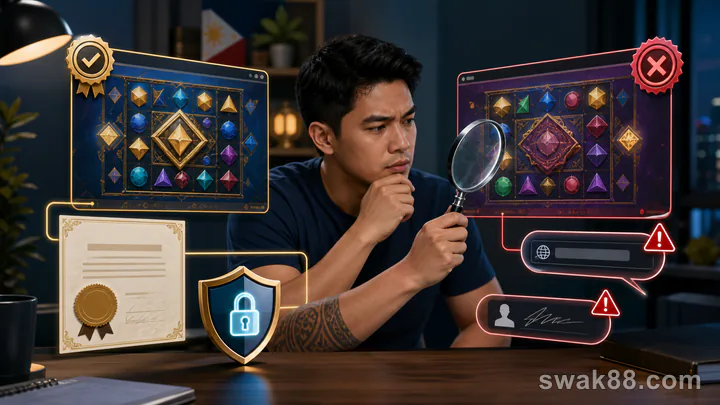
The Short Answer: Check the Game, Not Just the Casino
Is this casino game legit? It is when three things line up: the game comes from a real, named provider, it runs on a certified random number generator, and it behaves the same way everywhere it is hosted. When any of those three breaks — the provider name is slightly wrong, no testing certificate exists, or the game pays differently on one obscure site — you are probably looking at a clone, and clones are built so that you lose.
Most players in the Philippines already ask whether a casino is legit. Far fewer ask whether the game itself is. That gap is exactly what clone operators exploit: they copy the artwork, sounds, and title of a popular slot or table game, strip out the certified math, and host the fake version on unlicensed sites or sideloaded apps. This guide walks through how clones work, the checks that expose them, and what to do when a game fails those checks.
Why Fake Game Clones Exist
Popular games are popular targets. The studios Philippine players search for by name — JILI, Fa Chai, Pragmatic Play — are the same names clone operators imitate, because the familiar look does the selling. A slot that millions of players recognize is easier to fake than an unknown title. Clone operators take one of two approaches:
- Full visual copies. The fake reproduces the reels, symbols, and bonus screens of the original. Because the clone does not license the real game engine, its outcomes are not generated by the provider's certified RNG — the operator controls them directly.
- Near-name imitations. The game or app uses a slightly altered title or logo of a well-known game or studio. These often circulate as APK files shared through chat groups and social media rather than official app stores.
The business model is simple: familiar branding brings deposits in, and uncertified math makes sure very little goes back out. A legit casino game cannot quietly change its payout behavior, because the certified build is tested and hash-verified; a clone has no such constraint.
7 Checks That Expose a Clone
Run these in order. Most fakes fail within the first three.
- Confirm the provider actually makes this game. Go to the game studio's official website and look for the title in its game catalog. Major studios in this market — JILI, Fa Chai, Pragmatic Play, and their peers — all publish their game lists publicly. If the studio has no record of the game, the version you found is not theirs.
- Check where you found it. Certified games are distributed to licensed casinos through official channels. A game reached through a link in a group chat, a sideloaded APK, or a site with no license information is outside that channel.
- Look for the license behind the lobby. In the Philippines, locally licensed operators fall under PAGCOR oversight, and offshore sites should display a verifiable license from their own regulator in the site footer. No license means no one is auditing the games at all.
- Verify a testing certificate exists. Regulated markets require every certified game build to pass an independent testing laboratory's audit before release, and providers and licensed casinos state that certification on their sites. Clones never mention testing at all, because an audit would immediately expose uncertified math.
- Compare the RTP disclosure. Open the game's info or paytable screen. Real games state their return-to-player percentage and detailed rules there. A missing paytable, a blank info screen, or an RTP wildly above what the provider publishes for that title are all clone signals.
- Test the demo version. Most real slots and RNG table games offer a free demo mode through the provider or licensed casinos. Clones frequently skip demo mode entirely — free play earns them nothing — or offer a demo that wins suspiciously often to bait deposits.
- Watch early-session behavior. A common clone pattern is a hot start: frequent wins at low stakes, then a sharp turn once you raise your bet or try to withdraw. Certified RNG games do not react to your balance or your withdrawal requests.
Legit Game vs Clone: What Each Looks Like
| Signal | Legit casino game | Likely clone |
|---|---|---|
| Provider | Named studio; title listed in its official catalog | No studio named, or name slightly misspelled |
| Distribution | Licensed casino lobbies, official app stores | Sideloaded APKs, chat-group links, unlicensed sites |
| Certification | Independent lab testing stated by provider or casino | Testing never mentioned anywhere |
| Paytable and rules | Full rules and stated RTP inside the game | Missing, incomplete, or inflated numbers |
| Demo mode | Usually available before depositing | Absent, or demo pays out unrealistically |
| Payout behavior | Consistent with published RTP over time | Hot start, then sudden losing streaks after bigger bets |
None of these signals is proof on its own — a small licensed casino may also skip demo mode, for example — but a game that fails two or more checks is not worth your deposit.
Where Clones Usually Show Up
Knowing the distribution pattern saves you from running every check on every game. Cloned casino games in the Philippine market cluster in a few places:
- Unofficial Android APKs promoted through social media ads, promising bonuses that licensed apps supposedly cannot match.
- Unlicensed websites that assemble logos from several famous studios on one page, with no license number anywhere on the site.
- Messaging-app casinos where an agent takes deposits through a chat and links you to a hosted game page.
The common thread is that each route bypasses the official provider-to-casino distribution chain. If you stay inside that chain — licensed casino, official app store, provider-listed game — you have already eliminated most clone risk. Before you deposit anywhere new, it is worth running the site itself through a full vetting process; our checklist for verifying a legit online casino covers licensing, payments, and support checks step by step.
What To Do When a Game Fails the Checks
If a game you are already playing shows clone signals, stop in this order:
- Stop betting immediately. Do not chase losses inside a game you suspect is uncertified — the math you are playing against is unknown.
- Attempt a withdrawal of your remaining balance. Withdrawal friction is itself diagnostic: legit operators process requests through documented channels, while clone hosts typically stall, add surprise "verification fees," or go silent.
- Document everything. Screenshot the game screen, the site address, deposit records, and any chat with support.
- Report the operator. For sites claiming Philippine licensing, PAGCOR accepts player reports; for offshore sites, report to the named regulator if one exists. Your report will not always recover funds, but it builds the record that gets fake operators blocked.
- Re-check the real version. If the game itself was the draw, find the authentic title through the provider's catalog and play it only at a casino you have vetted. Understanding how certified games prove their fairness — RNG testing, RTP publication, and audit trails — is covered in our guide to checking casino game fairness.
Pre-Deposit Checklist
Before you put money behind any casino game in 2026, confirm:
- The game's studio is named, and the title appears in that studio's official catalog
- You reached the game through a licensed casino or official app store, not a shared link or APK
- The hosting site displays a verifiable license (PAGCOR locally, or a named offshore regulator)
- Independent lab testing of the provider's games is stated on the provider's or casino's site
- The in-game paytable shows full rules and an RTP consistent with the provider's published figure
- Demo mode exists and behaves like a normal game, not a winning streak generator
- You have set a deposit limit before your first real bet
A legit casino game passes all of these without friction, because the legitimate industry is built to be checkable. The moment a game resists verification — no provider, no license, no certificate, no paytable — treat that resistance as the answer.
Related Reading
For a closely related guide on this site, read Trying an Online Casino New to the Philippines? 7 Checks to Run Before Your First Deposit in 2026.